



Em meio à seca mais severa dos últimos 100 anos, sistemas agroflorestais resistem como solução ambiental, econômica e alimentar para populações impactadas
Texto: Camila Garcêz / Idesam
“A gente não encontra quase nenhum peixe nesse rio, só se der sorte. A gente tem fruta também, tem horta. A horta a gente ainda consegue aguar né, que tá aqui do lado de casa. Mas é assim que a gente tem vivido, apertado, mas tá vivendo”, conta Aldemir Queiroz, de 61 anos, extrativista e morador da Reserva de Desenvolvimento Sustentável (RDS) do Uatumã há 58 anos. Ele menciona os impactos da seca severa que tomou conta do Rio Uatumã, região que sofre as consequências da vazante dos rios amazônicos. Esta, que é a pior seca dos últimos 121 anos, fez com que o Rio Negro, em Manaus, atingisse a marca histórica de 13,59 cm no dia 16 de outubro de 2023.
A estiagem trouxe consequências severas para as populações de 62 municípios do estado do Amazonas, que decretaram situação de emergência. A dificuldade no acesso à água potável e alimentos é grande em diversas regiões, incluindo a comunidade de Santa Luzia do Caranatuba, que está localizada bem no meio da reserva e abriga cerca de 40 famílias, que vivem exclusivamente do extrativismo e do plantio para a subsistência. O sistema agroflorestal (SAF) da RDS do Uatumã, hoje conta com quase 100 árvores de pau-rosa e outras 4.210 árvores frutíferas, medicinais e madeireiras. Criado por Seu Aldemir, sua esposa, Dona Neide Santos, 57, e os nove filhos, o SAF tem sido a principal fonte de alimento durante a emergência climática.
“Quando a gente tava plantando aqui chamavam nós de maluco, porque a gente começou a plantar muda de pau-rosa. Diziam que isso não tinha futuro, que não ia dar certo e agora tá aí nosso SAF, cheio de árvore, que dá comida pra nós, dá fruta, dá madeira, dá alimento né, que nesses tempos agora importa muito. Se não fosse essa terra, a gente não tinha o que comer”, comenta Dona Neide, mostrando como a agrofloresta tem sido uma importante aliada para a segurança alimentar da família, já que a vazante tem dificultado viagens até a cidade.

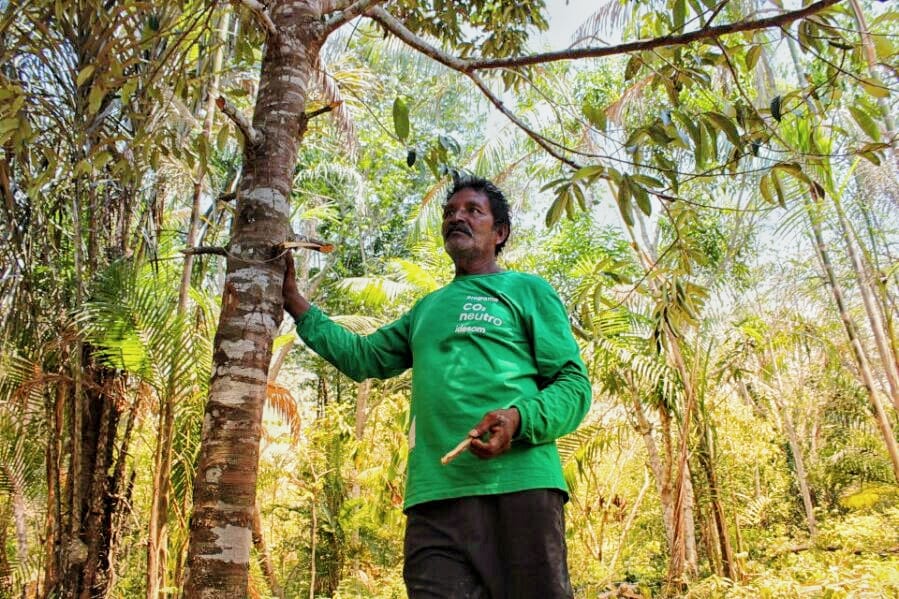
Seu Aldemir e Dona Neide em sua casa, na comunidade Santa Luzia do Caranatuba. Foto: Camila Garcêz/ Idesam
Para sobreviver, Seu Aldemir, aos 14 anos de idade, se tornou explorador da árvore Aniba rosaeodora, mais conhecida como pau-rosa. Durante 12 anos de sua vida, ele realizou a prática ilegal em troca de comida e quinhentos cruzeiros, como ele mesmo conta, oferecidos por madeireiros que entravam nas comunidades com barcos cheios de comida, remédios e outros mantimentos.
“Quando eu era explorador de pau-rosa eu derribava, tirava pelo tronco e ainda deixava a galhada lá pelo chão’, relembra. “Vamo dizer se nós tivesse conhecimento como agora, nunca tinha perdido as árvores pra exploração. Hoje eu penso assim, das 5 mil árvores que eu explorei e se elas tivesse em pé dentro da reserva agora?”, questiona, avaliando as práticas de extração de madeira ilegal na Amazônia, em meados dos anos 80.
Naquela época a fiscalização quase não existia e a árvore de pau-rosa, nativa da Amazônia e de óleo essencial poderoso para a indústria da perfumaria e cosméticos, foi explorada intensamente na região. De acordo com dados da Superintendência do Desenvolvimento da Amazônia (Sudam), cerca de 2 milhões de árvores da espécie foram exploradas ilegalmente para a produção de óleo. Atualmente estima-se que o preço deste óleo, rico em linalol, seja o equivalente a R$ 5 mil o litro, mas o manejo inadequado da espécie a colocou na Lista Oficial de Espécies da Flora Brasileira Ameaçadas de Extinção, do Ibama.
De predador do pau-rosa, Seu Aldemir passou a ser um agente de conservação da espécie dentro da RDS do Uatumã. A criação da agrofloresta começou quando ele passou a levar para germinar em seu terreno, as sementes e ramos que encontrava durante a exploração ilegal da madeira. “Eu peguei uma semente dessa quando eu tava na mata cortando. Eu trouxe pra cá, botei num saquinho, ela germinou e hoje elas tão aí enorme, gigantes”, relembra com admiração.
Com a criação da RDS em 2004 e a elaboração do Plano de Gestão feito pelo Idesam, a população ribeirinha às margens do rio Uatumã viu a realidade de exploração ilegal de madeira, caça e pesca mudar drásticamente. As mais de 350 famílias divididas pelas 22 comunidades da reserva, que viviam predominantemente da produção agrícola com derrubada e queima de árvores, tiveram apoio para mudar suas perspectivas de desenvolvimento econômico. Isso foi essencial para que a mudança de pensamento em relação aos SAFs pudesse acontecer.
Resiliência da floresta
A floresta vista de cima parece sem fim. Um grande tapete verde cortado por rios-serpentes que também se agigantam nesse cenário. Mas, o percurso até a RDS do Uatumã, quando feito de cima, também revela focos de incêndios em áreas de mata fechada. São como feridas que se abrem em clarão por entre as copas verdes das árvores. A fumaça dessas árvores queimadas, se soma a outras, vindas de cidades com intensa atividade agropecuária, como Autazes e Careiro da Várzea, conforme denunciou o Ibama.

Floresta queimando. Foto: Camila Garcêz/ Idesam
Na agricultura convencional, as queimadas são um meio rápido e relativamente econômico para abrir grandes extensões de terra, eliminando a vegetação existente. As cinzas resultantes da queima, fornecem nutrientes às plantas e tornam o solo mais fértil. No entanto, essa prática traz impactos negativos para o meio ambiente, pois emite uma grande quantidade de carbono na atmosfera, degrada o solo e impacta a biodiversidade vivente naquela região.
Essa atividade associada ao calor e à seca extrema, levou Manaus e cidades da zona metropolitana a um número recorde de queimadas nos primeiros 15 dias de outubro. A região ficou sob intensa névoa de fumaça. Foram três dias seguidos, que levaram a capital do Amazonas ao segundo lugar no ranking de cidades com o pior ar para se respirar no mundo, de acordo com monitoramento da World Air Quality Index, e cerca de dois meses sem nenhuma solução efetiva para o problema.
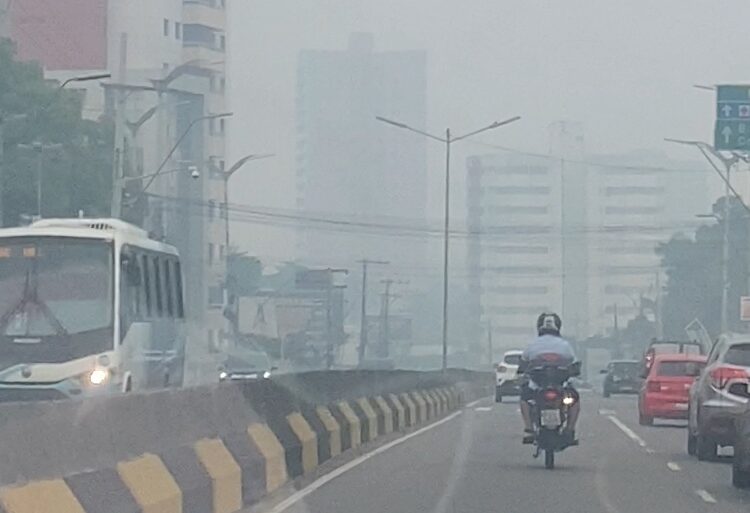
Manaus sob intensa névoa de fumaça. Foto: Camila Garcêz/ Idesam
No Amazonas, as estações do ano se dividem entre cheia e seca. Isso se baseia no número de chuvas em determinados períodos do ano, que interfere diretamente no volume de água dos rios. No período de seca os focos de incêndio se intensificam, já que além das florestas secarem pela falta de água e se tornarem suscetíveis, elas também são alvo do desmatamento e de queimadas criminosas. Eu, como jornalista, pude presenciar de perto essa destruição.
Depois de atravessar as nuvens de fumaça, pousamos no meio do Rio Uatumã. Estive nesse mesmo lugar em junho deste ano e o que vi foram realidades completamente diferentes da que vejo agora. O rio que antes tinha quase 2km de extensão de uma margem à outra, agora corre em um filete de água. Em seguida, entramos em uma lancha que nos aguardava. Tivemos dificuldade em chegar à margem pelo alto risco de encalharmos, e precisamos da ajuda do anfitrião do lugar, que veio de canoa para nos levar até lá. Seu Aldemir franzia o olhar na tentativa de defender o rosto do sol enquanto nos contava as dificuldades trazidas pelo forte verão amazônico.
“Foi três vez nós caminhando aqui ontem. Três vez, ida e volta, pra poder sair”, ele diz, apontando o caminho que teríamos que percorrer para chegar até a sua casa, um percurso de mais ou menos 2 km. No contexto de uma vazante normal, esse caminho não teria a necessidade de ser feito, considerando que a canoa conseguiria parar em frente a casa dele.
Nós caminhamos debaixo de um sol escaldante, quase sem vento e usando o pouco de árvores que encontramos à beira da praia para nos proteger. Estava ali acompanhando a equipe técnica do Idesam que monitora o SAF de Seu Aldemir e foi acompanhar os efeitos provocados pela seca no viveiro de mudas construído no terreno, que tem por objetivo levar o plantio de pau-rosa a outros SAFs dentro da reserva. “Eu comecei a plantar mais umas mudinhas do ano passado pra cá, trezentos pé, só que já morreu a metade. Essa seca tá destruindo tudo, tavam pequena ainda e não resiste ao calor que é muito forte. Olha como as árvores grande tão sentindo o verão”, diz, apontando para os galhos secos das árvores maiores.
“Eu tô triste né, tô triste por causa desse verão grande, se eu tivesse como ter um irrigamento pra continuar dando água pra elas, vamo dizer de três em três dias ou então, de quinze em quinze dias que fosse, pra mim era bom. Aqui já teve pra mais de 30 dias sem chuva, aí elas não aguentam. E aí a gente tá tendo esse verão forte, mas pode vir um outro verão mais forte ainda pela frente, a gente não sabe”, comenta cabisbaixo.
A preocupação de Seu Aldemir reflete um desafio comum enfrentado pelos guardiões dos SAFs na Amazônia. “A história dele mostra como é difícil cuidar da terra em um mundo mais quente e de clima mais instável”, ilustra a pesquisadora e presidente do Instituto Talanoa de Políticas Climáticas, Natalie Unterstell.
Ela explica que estratégias de adaptação a esses impactos, como sistemas de irrigação eficazes e variedades de plantas mais resistentes ao calor e à seca, devem ser planejadas em conjunto pelo Poder Público, comunidades locais e Organizações da Sociedade Civil, para desenvolver políticas que fortaleçam a criação de zonas tampão, uma área que atua como barreira entre dois ambientes, protegendo os SAFs de incêndios florestais e fortalecendo as políticas de uso da terra para evitar o desmatamento ilegal.
Natalie, que já esteve à frente de negociações nas Conferências das Partes (COP) e arquitetou o primeiro acordo de florestas da Organização das Nações Unidas (ONU), conta que os SAFs são uma importante medida para a mitigação climática, além de serem uma alternativa sustentável encontrada pelos agricultores, que podem plantar alimentos e cuidar da floresta ao mesmo tempo.
“Em um cenário de desmatamento e savanização, os sistemas agroflorestais têm um papel crucial na regeneração da floresta e na mitigação das mudanças climáticas. Estes sistemas combinam agricultura e floresta, preservando a biodiversidade e melhorando a qualidade do solo. Os principais benefícios incluem a conservação dos recursos hídricos, aumento da resiliência climática e manutenção da biodiversidade. Os SAFs também ajudam a capturar carbono, um fator essencial na luta contra as mudanças climáticas”, salienta.
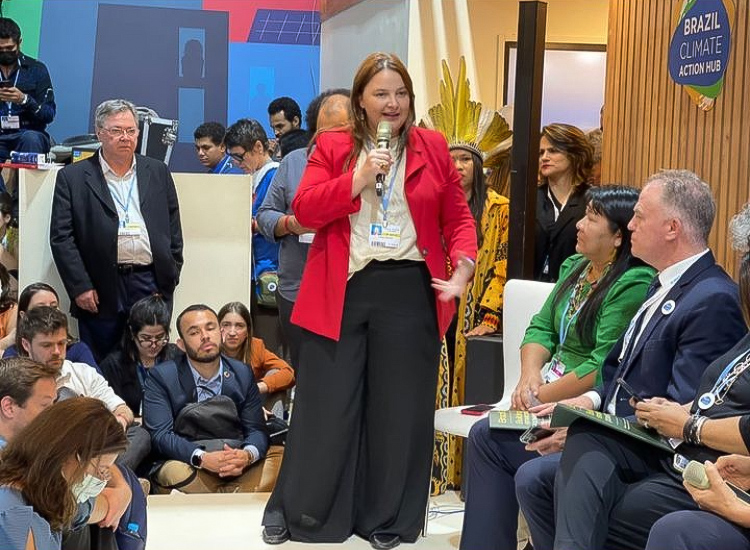
Natalie Unterstell em discurso na COP27. Foto: Arquivo pessoal
A preocupação de Seu Aldemir em relação aos verões intensos que podem vir no futuro, é baseada em sua experiência e no conhecimento da terra. Seu olhar atento para os fenômenos climáticos em constante agravamento, demonstra uma preocupação genuína com o compromisso de conservar a natureza. A floresta e seus povos estão sofrendo. Aproximadamente 600 mil pessoas já foram diretamente afetadas pela seca, de acordo com a Defesa Civil Estadual. Milhares de animais, como botos e peixes, foram encontrados mortos devido ao aumento da temperatura da água e deslizamentos de terras já causaram vítimas fatais no Amazonas, durante a estiagem.
Para Natalie, este cenário de mudanças do clima deve agravar os desafios enfrentados pela Amazônia, incluindo secas ainda mais severas e frequentes e perda de biodiversidade, já que as projeções climáticas apontam um ressecamento da floresta e uma grande instabilidade no regime de chuvas.
“Os sistemas agroflorestais podem desempenhar um papel vital na adaptação e mitigação a esses desafios. Para promover a adoção generalizada dessas práticas, é necessário investir em políticas públicas favoráveis e incentivos econômicos para os agricultores. Abrir linhas de financiamento nos fundos climáticos – como o Fundo Clima e o Fundo Amazônia – também podem ser medidas práticas para curto prazo”, destaca a pesquisadora.
Ampliando as dimensões do que é um SAF
“Um sistema agroflorestal, na verdade, é o homem imitando a natureza”. É o que diz Elen Blanco, gestora de projetos na Iniciativa de Serviços Ambientais do Idesam. Ela conta que esses sistemas representam uma estratégia de combinação de espécies, que permite a recuperação de áreas degradadas, produção de alimentos e sequestro de carbono, oferecendo uma maneira de aproveitar os recursos naturais, sem comprometer a saúde da floresta.
“Se a gente voltar na história lá atrás, quando ainda éramos coletores e caçadores, na mesma área a gente tinha maçã, milho, banana, ou seja, tinha várias espécies vivendo juntas, cada uma no seu extrato. Então tem plantas mais baixinhas, plantas médias, plantas mais altas, e aí a gente começou a imitar isso. O sistema agroflorestal nada mais é do que essa imitação da própria natureza”, conta. Além disso, ela menciona que a proposta do SAF é de otimizar o uso de recursos naturais, ou seja, indivíduos de diferentes alturas irão captar luz solar em diferentes estratos, assim como, as raízes com diferentes profundidades irão absorver nutrientes em diferentes locais.
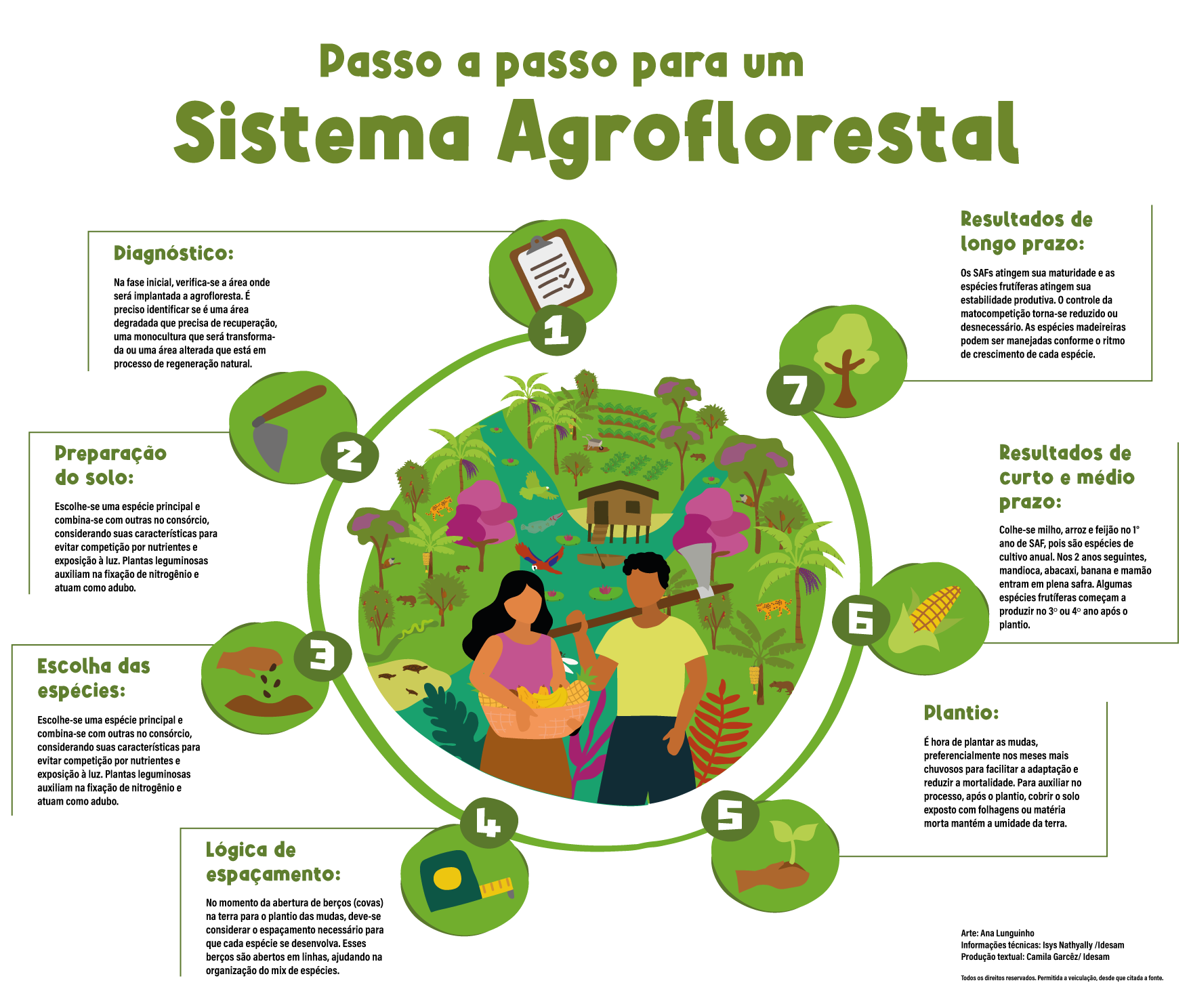
Entenda como funciona um SAF. Clique na imagem para ver mais.
Essa prática tradicional, combinada com a assistência técnica do Idesam, fortaleceu as agendas de bioeconomia e cadeias produtivas sustentáveis para as comunidades ribeirinhas da reserva. Desde 2010, o Idesam coordena o Programa Carbono Neutro (PCN), um programa de compensação de emissões de gases de efeito estufa (GEEs), por meio da implementação de SAFs em áreas degradadas da RDS do Uatumã.
“Hoje temos uma calculadora para pessoa física, e para pessoas jurídicas fazemos um inventário de emissões. Depois que a gente tem esse total da tonelada de carbono, fazemos um cálculo para entender quantas árvores são necessárias para compensar as emissões de carbono equivalentes. Atrelamos um valor em reais a cada árvore e esse recurso vai viabilizar o plantio, que vai ter esse triplo papel, de recuperação de áreas degradadas, de compensação de carbono e também na segurança alimentar das comunidades. Então a gente vai ter uma área restaurada, uma área que está sequestrando carbono da atmosfera e ainda está tendo um papel social para as comunidades”, explica Ellen.
Com mais de uma década de atuação, o Programa Carbono Neutro já realizou o plantio de 50 mil árvores em SAFs dentro da Reserva do Uatumã. Em uma área de cerca de 30 hectares, mudas de cacau, cupuaçu, açaí, andiroba, cumaru, ipê, breu branco, pau-rosa castanheira, entre outras, foram consorciadas, sendo equivalente a mais de 10 mil toneladas de CO2 neutralizadas. Dentro dos SAFs, os técnicos do Idesam, junto às mais de 40 famílias participantes do Programa, combinam o cultivo de espécies agrícolas, com árvores nativas e outros elementos da floresta. No site do Idesam, é possível acompanhar o mapa de plantio, que mostra em quais áreas da RDS, as árvores foram plantadas.
Ao contrário das monoculturas intensivas, que exploram o solo e o deixam improdutivo depois de dois ou três ciclos de colheitas, esses sistemas criam microcosmos que se assemelham à estrutura natural da floresta e geram uma produtividade na agricultura, estendida para mais de 30 anos. Os SAFs também geram novas formas de economia, a partir do cultivo, ao invés de substituir a floresta por campos, os SAFs integram o cultivo com a floresta, mantendo a cobertura vegetal e a diversidade biológica.
Produtividade e renda com a floresta viva
Outra experiência de relação harmônica entre meio ambiente e seres humanos está em Apuí, na região sul do Amazonas. O município foi eleito campeão nacional do desmatamento na Amazônia em 2022, segundo monitoramento do Instituto do Homem e Meio Ambiente da Amazônia (Imazon). A fronteira agrícola avança ano após ano em direção à floresta, tornando a região conhecida como arco do desmatamento.
Com intensa atividade agropecuária e inúmeras commodities de soja e milho, Apuí guarda o fruto da resiliência e da esperança das famílias agricultoras que, na contramão das atividades ao seu redor, persistem no cultivo do café em agrofloresta como forma de subsistência.
O Café Apuí Agroflorestal é o primeiro café agroflorestal produzido de forma sustentável na Amazônia brasileira. Um café premium, robusta, com certificação orgânica e produzido por agricultores familiares. Essa foi a alternativa sustentável encontrada pelas famílias produtoras, para produzir um café de qualidade, aliando saberes tradicionais e conhecimento técnico, mesmo dentro de um cenário de devastação da floresta.

Café Apuí Agroflorestal. Foto: Flicker/ Idesam
No passado, muitos produtores abandonaram seus cafezais tradicionais pela baixa produtividade. Mas hoje, cerca de 80 famílias parceiras integram a produção, que uniu o conhecimento e quem trabalha no campo, junto à expertise técnica do Idesam e da empresa Amazônia Agroflorestal, criando um cultivo de café manejado. Dados de 2022, apontam que a produção de café agroflorestal, alcançou uma receita média de R$ 7 mil por hectare/ano, valor dez vezes maior que a pecuária predatória.
De histórias de sucesso em comunidades locais até as implicações mais amplas para a proteção da biodiversidade e redução dos impactos das mudanças do clima, vemos que essa prática ancestral está se transformando em um farol de esperança para a conservação da floresta amazônica diante do agravamento dos eventos climáticos extremos, enquanto nutre as vidas das pessoas que a chamam de lar.
Quando falamos em Amazônia, imaginamos uma perspectiva de povos da floresta unicamente indígena, mas dentro dela, existem muitas outras formações sociais que também estão na luta pela defesa deste bioma, buscando maneiras sustentáveis de produzir, sem causar impactos nocivos ao lugar onde vivem.
São ribeirinhos, caboclos, extrativistas, como o Seu Aldemir, que entenderam que esse lugar é valioso exatamente porque está vivo e de pé e que ao associar o apoio técnico e o trabalho das organizações sociais que trabalham em prol da Amazônia, junto às práticas milenares de cultivo agroecológico, é possível abraçar a oportunidade de quebrar um ciclo exploratório que põe em risco a natureza e a própria existência.
“Hoje em dia, graças a Deus, eu sou um espelho pros outros. Eu passei a não trabalhar mais com madeira clandestina, comecei a olhar de outra maneira pra dentro da reserva. Na partida que eu comecei a trabalhar no caminho que me indicaram, hoje graças a Deus eu rezo muito pra que eu não saia desse caminho, eu procuro fazer as coisas certa e eu incentivo os outros a fazer também, porque eu tô aqui preservando não é só pra mim. Eu tenho muito filho, tenho neto, então pros meu neto ver, porque senão daqui mais uns tempo não vai ter mais nada”, finaliza Aldemir.

Seu Aldemir caminha na agrofloresta de pau-rosa. Foto: Camila Garcêz/ Idesam
Créditos gerais:
Esta foi uma produção jornalística apoiada pelo projeto Get Ready For The COP28, da ONG Saúde e Alegria e da DW Akademie, que levará 10 jornalistas da Amazônia para a cobertura do maior evento de discussão climática do mundo, a COP28 a ser realizada este ano em Dubai. Agradecimento especial ao Idesam por todo apoio, na pessoa da Paola Bleicker, diretora executiva.
Texto: Camila Garcêz/ Idesam
Pesquisa, texto e ideia Infográfico: Camila Garcêz/ Idesam
Revisão de texto: Steffanie Schmidt e Larissa Mahall
Revisão técnica e apoio de produção: André Vianna, Marcus Biazatti e Victória Bastos/ Idesam
Design Gráfico Infográfico: Ana Lunguinho
Informações técnicas Infográfico: Isys Nathyally/ Idesam
Mapa e animação: Camila Garcêz/ Idesam
Fotografia: Camila Garcêz/ Idesam e Flicker/ Idesam
Mentoria: Lu Sudré
Mentoria de Mapa e Infográfico: Hyury Potter[:en]In the midst of the most severe drought in 100 years, agroforestry systems resist as an environmental, economic and food solution for impacted populations
Text: Camila Garcêz / Idesam
“We hardly find any fish in this river, only if we’re lucky. We also have fruit, we have a vegetable garden. We can still water the vegetable garden, because it’s right next to our house. But that’s how we’ve been living, tight, but we’ve been living,” says Aldemir Queiroz, 61, an extractivist who has lived in the Uatumã Sustainable Development Reserve (SDR) for 58 years. He mentions the impacts of the severe drought that has taken hold of the Uatumã River, a region that suffers the consequences of the Amazonian rivers’ ebb and flow. This, the worst drought in 121 years, caused the Rio Negro, in Manaus, to reach the historic mark of 13.59 cm on October 16, 2023.
The drought has had severe consequences for the populations of 62 municipalities in the state of Amazonas, which have declared a state of emergency. The difficulty in accessing drinking water and food is great in several regions, including the community of Santa Luzia do Caranatuba, which is located right in the middle of the reserve and is home to around 40 families who live exclusively from extractivism and subsistence planting. The agroforestry system (SAF) in the Uatumã RDS has almost 100 rosewood trees and another 4,210 fruit, medicinal and timber trees. Created by Seu Aldemir, his wife, Dona Neide Santos, 57, and their nine soon, the SAF has been the main source of food during the climate emergency.
“When we were planting here, people called us crazy because we started planting rosewood seedlings. They said it had no future, that it wouldn’t work, and now there’s our SAF, full of trees, which give us food, fruit, wood, food, which in these times matters a lot. If it weren’t for this land, we wouldn’t have anything to eat,” says Dona Neide, showing how agroforestry has been an important ally for the family’s food security, since the low water levels have made it difficult to travel to the city.
Seu Aldemir and Dona Neide at their home in the Santa Luzia do Caranatuba community. Photo: Camila Garcêz/ Idesam
In order to survive, Seu Aldemir, at the age of 14, became an exploiter of the Aniba rosaeodora tree, better known as rosewood. For 12 years of his life, he carried out the illegal practice in exchange for food and five hundred cruzeiros, as he tells it, offered by loggers who entered the communities with boats full of food, medicine and other supplies.
“When I was a rosewood explorer, I used to cut it down, take it out by the trunk and leave the branches on the ground,” he recalls. “Let’s say that if we had the knowledge we have now, we would never have lost the trees to exploitation. Today I think, of the 5,000 trees I exploited, what if they were standing in the reserve now?” he asks, evaluating the practices of illegal logging in the Amazon in the mid-80s.
At the time, there was almost no enforcement and the rosewood tree, native to the Amazon and producing powerful essential oil for the perfumery and cosmetics industry, was intensively exploited in the region. According to data from the Superintendence for the Development of the Amazon (Sudam), around 2 million trees of this species were illegally exploited to produce oil. It is currently estimated that the price of this oil, which is rich in linalool, is the equivalent of R$5,000 a liter, but improper management of the species has put it on Ibama’s Official List of Brazilian Flora Species Threatened with Extinction.
From being a predator of rosewood, Mr. Aldemir became an agent for the conservation of the species within the Uatumã RDS. The creation of the agroforest began when he started taking the seeds and branches he found during illegal logging to germinate on his land. “I picked up one of these seeds when I was in the forest cutting. I brought it here, put it in a sachet, it germinated and today they are huge, gigantic,” he recalls with admiration.
With the creation of the RDS in 2004 and the preparation of the Management Plan by Idesam, the riverside population on the banks of the Uatumã River saw the reality of illegal logging, hunting and fishing change drastically. The more than 350 families divided among the reserve’s 22 communities, who used to live predominantly from agricultural production with the felling and burning of trees, were given support to change their outlook for economic development. This was essential for the change in thinking about SAFs to take place.
Forest resilience
The forest from above seems endless. A great green carpet cut by snaking rivers that also loom large in this scenery. But the route to the Uatumã RDS, when taken from above, also reveals fires in areas of closed forest. They are like wounds that open up in a flash between the green treetops. The smoke from these burnt trees is added to other smoke coming from towns with intense farming activity, such as Autazes and Careiro da Várzea, as Ibama has denounced.
Forest burning. Photo: Camila Garcêz/ Idesam
In conventional agriculture, burning is a quick and relatively inexpensive way to open up large tracts of land by eliminating existing vegetation. The ash resulting from burning provides nutrients for plants and makes the soil more fertile. However, this practice has negative impacts on the environment, as it emits a large amount of carbon into the atmosphere, degrades the soil and impacts the biodiversity living in the area.
This activity, coupled with the extreme heat and drought, led Manaus and cities in the metropolitan area to a record number of fires in the first 15 days of October. The region was engulfed in an intense haze of smoke. It was three days in a row, which took the capital of Amazonas to second place in the ranking of cities with the worst air to breathe in the world, according to monitoring by the World Air Quality Index, and about two months without any effective solution to the problem.
Manaus under an intense haze of smoke. Photo: Camila Garcêz/ Idesam
In the Amazon, the seasons are divided into flood and drought. This is based on the amount of rainfall at certain times of the year, which directly affects the volume of water in the rivers. During the dry season, fire outbreaks intensify, as not only do the forests dry out due to the lack of water and become susceptible, but they are also the target of deforestation and arson. As a journalist, I have witnessed this destruction up close.
After crossing the clouds of smoke, we landed in the middle of the Uatumã River. I was there in June of this year and what I saw were completely different realities to what I see now. The river, which used to be almost 2km long from one bank to the other, now flows in a trickle. As soon as we landed on the river, we got into a speedboat that was waiting for us. We had difficulty reaching the shore due to the high risk of running aground, and needed the help of the local host, who came by canoe to take us there. Mr. Aldemir frowned in an attempt to defend his face from the sun as he told us about the difficulties brought on by the strong Amazonian summer.
“We walked here three times yesterday. Three times, back and forth, to be able to leave,” he says, pointing out the path we would have to take to get to his house, a distance of about 2 km. In the context of a normal ebb, this route wouldn’t be necessary, considering that the canoe would be able to stop in front of his house.
We walked under the scorching sun, with almost no wind and using the few trees we found on the beach to protect us. I was there accompanying the technical team from Idesam that monitors Seu Aldemir’s SAF and was going to monitor the effects of the drought on the seedling nursery built on the land, which aims to take rosewood planting to other SAFs within the reserve. “I started planting some more seedlings last year, three hundred feet, but half of them have already died. This drought is destroying everything, they were still small and can’t withstand the heat, which is very strong. Look how the big trees are feeling the summer,” he says, pointing to the dry branches of the larger trees.
“I’m sad, right, I’m sad because of this long summer. If I could have irrigation to keep giving them water, let’s say every three days or every two weeks, that would be fine with me. Here we’ve had more than 30 days without rain, so they can’t stand it. And then we’re having this strong summer, but there could be another stronger summer ahead, we don’t know,” he says gloomily.
Seu Aldemir’s concern reflects a common challenge faced by the guardians of SAFs in the Amazon. “His story shows how difficult it is to take care of the land in a warmer world with a more unstable climate,” says researcher and president of the Talanoa Institute for Climate Policy, Natalie Unterstell.
She explains that strategies for adapting to these impacts, such as effective irrigation systems and plant varieties that are more resistant to heat and drought, should be planned jointly by the Government, local communities and Civil Society Organizations, to develop policies that strengthen the creation of buffer zones, an area that acts as a barrier between two environments, protecting SAFs from forest fires and strengthening land use policies to prevent illegal deforestation.
Natalie, who has led negotiations at the Conferences of the Parties (COP) and engineered the United Nations’ (UN) first forest agreement, says that SAFs are an important measure for climate mitigation, as well as being a sustainable alternative for farmers, who can grow food and look after the forest at the same time.
“In a scenario of deforestation and savannization, agroforestry systems play a crucial role in forest regeneration and climate change mitigation. These systems combine agriculture and forestry, preserving biodiversity and improving soil quality. The main benefits include conserving water resources, increasing climate resilience and maintaining biodiversity. SAFs also help to capture carbon, an essential factor in the fight against climate change,” he points out.
Natalie Unterstell speaking at COP27. Photo: Personal archive
Mr. Aldemir’s concern about the intense summers that may come in the future is based on his experience and knowledge of the land. His attentive eye for the constantly worsening climatic phenomena demonstrates a genuine concern for the commitment to conserve nature. The forest and its peoples are suffering. Approximately 600,000 people have already been directly affected by the drought, according to the State Civil Defense. Thousands of animals, such as dolphins and fish, have been found dead due to rising water temperatures and landslides have already caused fatalities in Amazonas during the drought.
For Natalie, this climate change scenario is likely to aggravate the challenges facing the Amazon, including even more severe and frequent droughts and loss of biodiversity, since climate projections point to a drying out of the forest and great instability in the rainfall regime.
“Agroforestry systems can play a vital role in adapting to and mitigating these challenges. To promote the widespread adoption of these practices, it is necessary to invest in favorable public policies and economic incentives for farmers. Opening up lines of financing in climate funds – such as the Climate Fund and the Amazon Fund – could also be practical short-term measures,” the researcher points out.
Expanding the dimensions of what a SAF
“An agroforestry system is actually man imitating nature”. So says Elen Blanco, project manager at Idesam’s Environmental Services Initiative. She says that these systems represent a strategy of combining species, which allows for the recovery of degraded areas, food production and carbon sequestration, offering a way of taking advantage of natural resources without compromising the health of the forest.
“If we go back in history, when we were still gatherers and hunters, in the same area we had apples, corn, bananas, in other words, there were several species living together, each in its own extract. So there are shorter plants, medium-sized plants, taller plants, and then we started to imitate this. The agroforestry system is nothing more than this imitation of nature itself,” she says. In addition, she mentions that the purpose of the SAF is to optimize the use of natural resources, i.e. individuals of different heights will capture sunlight in different strata, just as roots of different depths will absorb nutrients in different places.
Understand how a SAF works. Click on the image to see more.
This traditional practice, combined with Idesam’s technical assistance, has strengthened the bioeconomy and sustainable production chain agendas for the reserve’s riverside communities. Since 2010, Idesam has been coordinating the Carbon Neutral Program (PCN), a program to offset greenhouse gas (GHG) emissions by implementing SAFs in degraded areas of the Uatumã RDS.
“Today we have a calculator for individuals, and for companies we do an emissions inventory. Once we have this total ton of carbon, we calculate how many trees are needed to offset the equivalent carbon emissions. We attach a value in reais to each tree and this resource will make the planting possible, which will play this triple role of recovering degraded areas, offsetting carbon and also providing food security for the communities. So we’ll have a restored area, an area that is sequestering carbon from the atmosphere and is also playing a social role for the communities,” explains Ellen.
With more than a decade of activity, the Carbon Neutral Program has already planted 50,000 trees in SAFs within the Uatumã Reserve. In an area of around 30 hectares, seedlings of cocoa, cupuaçu, açaí, andiroba, cumaru, ipê, breu branco, pau-rosa castanheira, among others, have been intercropped, equivalent to more than 10,000 tons of CO2 neutralized. Within the SAFs, Idesam technicians, together with the more than 40 families participating in the Program, combine the cultivation of agricultural species with native trees and other elements of the forest. On the Idesam website, you can follow the planting map, which shows in which areas of the RDS the trees have been planted.
Unlike intensive monocultures, which exploit the soil and leave it unproductive after two or three harvest cycles, these systems create microcosms that resemble the natural structure of the forest and generate agricultural productivity extended to more than 30 years. SAFs also generate new forms of economy from cultivation: instead of replacing the forest with fields, SAFs integrate cultivation with the forest, maintaining vegetation cover and biological diversity.
Productivity and income with the living forest
Another experience of a harmonious relationship between the environment and human beings is in Apuí, in the southern region of Amazonas. The municipality was elected national champion of deforestation in the Amazon in 2022, according to monitoring by the Institute of Man and the Environment of the Amazon (Imazon). The agricultural frontier advances towards the forest year after year, making the region known as the arc of deforestation.
With intense agricultural activity and countless soy and corn commodities, Apuí bears the fruit of the resilience and hope of farming families who, against the background of the activities around them, persist in growing coffee in agroforestry as a form of subsistence.
Café Apuí Agroflorestal is the first sustainably produced agroforestry coffee in the Brazilian Amazon. It is a premium, robust coffee, certified organic and produced by family farmers. This was the sustainable alternative found by the producing families to produce quality coffee, combining traditional knowledge and technical know-how, even against a backdrop of forest devastation.
Café Apuí Agroflorestal. Photo: Flicker/ Idesam
In the past, many producers abandoned their traditional coffee plantations because of the low productivity. But today, around 80 partner families are part of the production, which has brought together the knowledge of those who work in the field, together with the technical expertise of Idesam and the company Amazônia Agroflorestal, creating a managed coffee crop. Figures from 2022 show that agroforestry coffee production has achieved an average income of R$7,000 per hectare per year, ten times more than predatory livestock farming.
From success stories in local communities to the wider implications for protecting biodiversity and reducing the impacts of climate change, we see that this ancient practice is becoming a beacon of hope for the conservation of the Amazon rainforest in the face of worsening extreme weather events, while nourishing the lives of the people who call it home.
When we talk about the Amazon, we imagine a perspective of only indigenous forest peoples, but within it, there are many other social formations that are also fighting to defend this biome, seeking sustainable ways of producing without causing harmful impacts on the place where they live.
They are river dwellers, caboclos, extractivists, like Seu Aldemir, who have understood that this place is valuable precisely because it is alive and kicking and that by associating technical support and the work of social organizations working on behalf of the Amazon, together with age-old practices of agroecological cultivation, it is possible to embrace the opportunity to break an exploitative cycle that puts nature and existence itself at risk.
“Nowadays, thank God, I’m a mirror for others. I no longer work with illegal timber, I started to look at the reserve differently. When I started working on the path they showed me, today, thanks to God, I pray a lot that I don’t stray from that path, I try to do the right things and I encourage others to do the same, because I’m here preserving not just for myself. I have a lot of children, I have grandchildren, so let my grandchildren see, because otherwise in a few years’ time there won’t be anything left,” concludes Aldemir.
Mr. Aldemir walks in the rosewood agroforest. Photo: Camila Garcêz/ Idesam
General credits:
This was a journalistic production supported by the Get Ready For The COP28 project, run by the NGO Saúde e Alegria and DW Akademie, which will take 10 journalists from the Amazon to cover the world’s largest climate discussion event, COP28, to be held this year in Dubai. Special thanks to Idesam for all their support, in the person of Paola Bleicker, executive director.
Text: Camila Garcêz/ Idesam
Research, text and idea Infographic: Camila Garcêz/ Idesam
Proofreading: Steffanie Schmidt and Larissa Mahall
Technical review and production support: André Vianna, Marcus Biazatti and Victória Bastos/ Idesam
Graphic Design Infographic: Ana Lunguinho
Technical information Infographic: Isys Nathyally/ Idesam
Map and animation: Camila Garcêz/ Idesam
Photo: Camila Garcêz/ Idesam and Flicker/ Idesam
Mentoring: Lu Sudré
Map and Infographic Mentoring: Hyury Potter